
 By kazimladimeji
Golf has always been a game of precision — and in 2025, that means more than just a smooth swing.
Modern golfers rely on rangefinders and GPS watches to make better club selections, hit more greens, and avoid hazards.
But if you’re new to the game, you might be wondering:
Do you really need one — and if so, which type suits you best?
Let’s break down how each device works, what they cost, and which golfers benefit most.
1. What’s the Difference Between a Rangefinder and a GPS Watch?
Although both help you gauge distance, they do it in completely different ways.
| Feature | GPS Watch | Laser Rangefinder |
|---|---|---|
| Measures | Distance to front/middle/back of green + hazards | Exact distance to visible target |
| How It Works | Uses GPS satellites + course maps | Uses laser to “ping” the flag or object |
| Speed | Instant, always-on readings | Requires aiming each time |
| Accuracy | ±2–4 yards | ±1 yard (very precise) |
| Ease of Use | Worn like a smartwatch | Hand-held monocular |
| Price Range (UK) | £150–£500 | £150–£450 |
In short:
-
A GPS watch gives you overall hole data at a glance.
-
A rangefinder gives you pin-point accuracy to any visible target.
2. The Case for GPS Watches
Best For: Beginners to intermediate golfers who value convenience and course awareness.
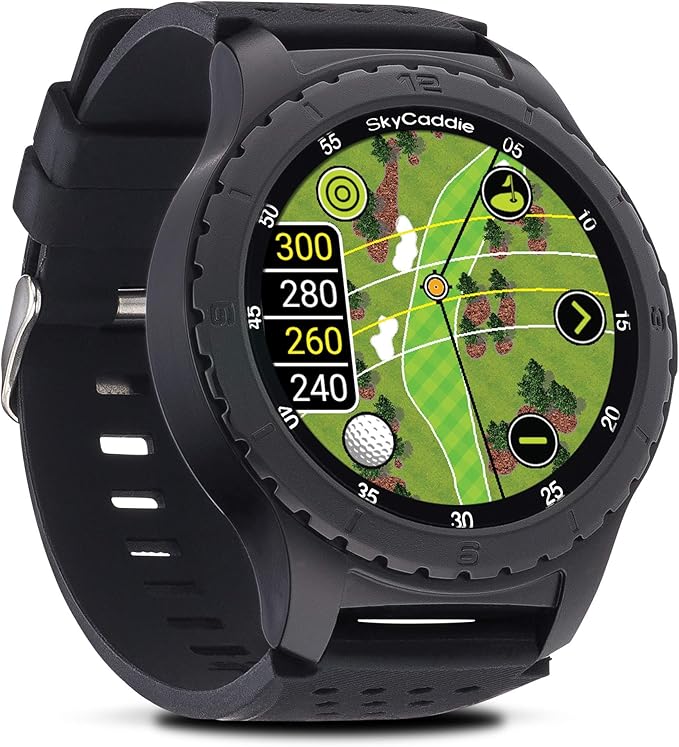 GPS watches have become the go-to gadget for recreational players because they’re simple, automatic, and hands-free.
Key Benefits
✅ Instant distances – No need to aim; just glance at your wrist.
✅ Course overview – See front/middle/back of the green and key hazards.
✅ Shot tracking – Many log your shots and club distances.
✅ Fitness features – Step count, heart rate, and notifications (on Garmin and Shot Scope models).
✅ Preloaded courses – Most come with 35,000+ global layouts, including all major UK tracks.
Top GPS Watches in 2025
| Model | Battery Life | Key Feature | Price |
|---|---|---|---|
| Garmin Approach S70 | 15 hrs (GPS) | AMOLED display + virtual caddie | ~£529 |
| Shot Scope G5 | 36 holes | Simple, clear yardages | ~£179 |
| Bushnell iON Edge | 16 hrs | Touchscreen, hazard mapping | ~£199 |
| Garmin Approach S12 | 30 hrs | Basic but reliable | ~£149 |
⛳ See our full guide: Best GPS Golf Watches (Garmin, Bushnell, Shot Scope etc.
When It’s Ideal
-
You’re new to golf and want simple yardage guidance.
-
You enjoy data — average shot distances, fairway hit rates, etc.
-
You play courses with lots of blind shots or hidden bunkers.
Potential Downsides
-
Less accurate than lasers for exact flag distance.
-
Doesn’t help much on driving ranges or practice areas.
-
You’re relying on satellite mapping — occasionally off by a yard or two.
🛒 Shop GPS Watches on Amazon UK
3. The Case for Laser Rangefinders
Best For: Confident golfers who want maximum precision.
 Rangefinders are a favourite of low handicappers and professionals. They’re all about accuracy — you get a direct line-of-sight measurement to whatever you aim at.
Key Benefits
✅ Pin-point accuracy – Within one yard of the target.
✅ Target anything – Flags, bunkers, lay-up points, trees.
✅ No reliance on GPS – Works anywhere, even on unlisted courses.
✅ Slope mode – Calculates adjusted yardages for elevation changes (legal for casual play).
Top Laser Rangefinders (2025)
| Model | Range | Key Feature | Price |
|---|---|---|---|
| Bushnell Tour V6 Shift | 1,300 yds | Slope + PinSeeker vibration | ~£429 |
| Nikon Coolshot 20 GIII | 800 yds | Compact, fast readings | ~£199 |
| Garmin Approach Z82 | 1,400 yds | GPS + laser hybrid | ~£549 |
| Shot Scope L2 | 700 yds | Value-friendly accuracy | ~£149 |
🏆 Fun Fact: Many Tour pros, including Rory McIlroy and Scottie Scheffler, use Bushnell lasers during practice rounds (though not in tournament play).
When It’s Ideal
-
You’re aiming for the flag, not just the green.
-
You’re playing competitions or precision-based rounds.
-
You like visual targeting and exact confidence in club selection.
Potential Downsides
-
Slower to use — you must aim at each target.
-
Can struggle in fog or heavy rain.
-
Requires a steady hand (practice helps).
4. Should You Buy Both?
Many golfers actually use both devices — a GPS watch for hole overview and a rangefinder for exact pin distances.
For example:
-
GPS watch: “140 to the middle, 152 to the back.”
-
Rangefinder: “147 to the pin.”
Together, they remove guesswork entirely.
But if you’re just starting out, it’s best to pick one and learn how it helps your game.
5. Cost Comparison (2025 UK Pricing)
| Type | Budget Range | Mid-Range | Premium |
|---|---|---|---|
| GPS Watch | £130–£180 (Shot Scope G5, Garmin S12) | £200–£350 (Bushnell iON Edge, Garmin S42) | £450–£550 (Garmin S70) |
| Rangefinder | £130–£180 (Shot Scope L2, Precision NX10) | £200–£350 (Nikon Coolshot GIII) | £400–£550 (Bushnell Tour V6 Shift, Garmin Z82) |
If you’re budget-conscious, a GPS watch offers more features for less money.
If you crave precision, the rangefinder wins hands-down.
6. Verdict: Which Is Right for You?
| Player Type | Recommended Tech | Why |
|---|---|---|
| Complete Beginner | GPS Watch | Hands-free, easy to use, broad data |
| Casual Golfer | GPS Watch or Both | Great for casual rounds + confidence |
| Improving Golfer | Laser Rangefinder | Refines accuracy and club gapping |
| Competitive Player | Both | Combines strategic and precision play |
⚖️ Bottom line: GPS for convenience. Rangefinder for precision. Both for perfection.
7. Our Recommendations
For most UK golfers starting out in 2025:
-
The Shot Scope G5 offers unbeatable simplicity and price.
-
The Bushnell Tour V6 Shift remains the laser to beat for serious players.
Final Thoughts
Technology can’t fix your swing — but it can sharpen your judgement.
Knowing your exact yardage builds confidence, speeds up play, and makes golf more strategic.
So whether you prefer a sleek GPS watch or a pin-point laser rangefinder, you’ll spend less time guessing and more time hitting greens.
And in 2025, that’s exactly how smart golfers play.
Related Reading
FAQs – Golf Rangefinders vs GPS Watches (2025)
Are rangefinders legal in golf competitions?
Yes — laser rangefinders are legal in most UK club and amateur competitions as long as slope or elevation modes are turned off. The R&A and USGA both permit distance-measuring devices that only measure yardage, not playing conditions.
Do GPS golf watches require a subscription?
Most modern watches — including Garmin, Shot Scope, and Bushnell — come with free lifetime course updates. Only a few premium apps or add-ons (e.g. Garmin Golf app analytics) might need optional paid features.
Which is more accurate — a GPS watch or a rangefinder?
A laser rangefinder wins for accuracy (usually within 1 yard).
However, a GPS watch gives you continuous distances to multiple points (front, middle, back of green), so it’s more useful for planning strategy, not just aiming.
Can beginners use a rangefinder effectively?
Absolutely — though there’s a learning curve. Beginners may find it easier to start with a GPS watch for simplicity, then move to a rangefinder once they want exact flag distances.
Do these devices work abroad or on holiday courses?
Yes. Most GPS watches include 35,000+ global courses, and rangefinders work anywhere. Just remember to charge devices before travel and check course mapping updates.
How long do batteries last?
-
GPS watches: typically 10–30 hours in GPS mode (1–3 rounds).
-
Rangefinders: 6–12 months per battery, since they only use power during use.